China Top Smart Photo Booth Suppliers for Global Buyers
China’s smart photo booth suppliers are serving a market shaped by events, retail activations, and social sharing. Grand View Research estimated the global photo booth market at USD 818.8 million in 2022, projecting an 8.4% compound annual growth rate from 2023 to 2030. That estimate covers photo booths broadly, not smart booths alone. Still, it signals meaningful demand for engaging, shareable experiences.
A memorable guest experience matters. Marketing expert Seth Godin wrote, “People do not buy goods and services. They buy relations, stories, and magic.” For global buyers, that idea has practical weight: a booth should do more than take a picture. It should produce clear images under mixed venue lighting, offer an intuitive touchscreen, and deliver files smoothly to guests. Small details count. A delayed print or confusing interface can leave a poor impression.
China offers buyers a wide supplier base, but product photos rarely tell the whole story. Compare camera and printer options, software features, customization limits, warranty terms, and spare-parts support. Ask for a live demonstration, not only a polished showroom video. Check how the supplier handles updates and technical questions across time zones. These checks are not glamorous. They are useful.
This guide introduces leading Chinese suppliers and the factors that distinguish them. It is not a substitute for direct testing. Specifications can change, and a strong quotation does not guarantee dependable after-sales service. Verify the details before placing an order.
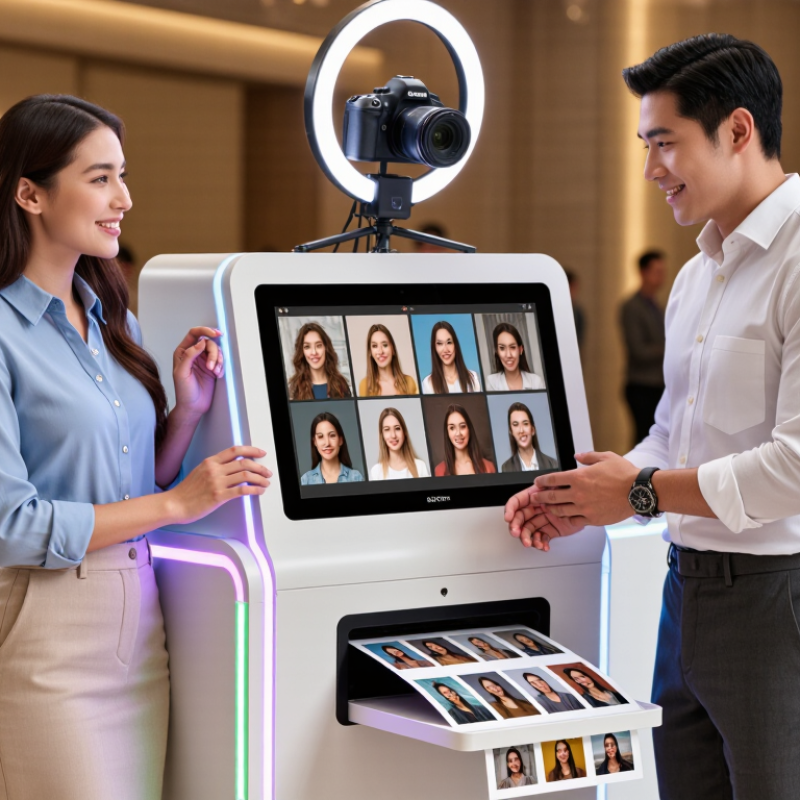
Defining Smart Photo Booths: Formats, Functions, and Global Buyer Needs
A smart photo booth combines image capture, software, and a clear guest workflow. The format shapes the experience. Open-air units suit busy halls and event spaces, while enclosed booths offer more privacy and controlled lighting. Compact kiosks can fit retail floors or hotel lobbies. Some systems are fixed installations; others use wheels and foldable frames for temporary venues. No format wins everywhere.
Core functions may include touchscreen guidance, instant printing, digital sharing, background replacement, and optional image effects. Buyers should check performance under uneven venue lighting, weak Wi-Fi, and long queues. A polished screen is not enough. Ask for sample prints, setup time, service intervals, and clear details on data storage and deletion. These checks can reveal more than a showroom demonstration.
Global buyers also need suitable power specifications, interface languages, printer supplies, installation guidance, and after-sales support across time zones. Request written technical specifications and test the actual workflow before ordering. A supplier’s stated capacity may not match a crowded event; that gap is easy to miss. Consider who will reload paper, troubleshoot errors, and keep the booth running when staff are busy.
China’s Supplier Landscape: OEM, ODM, and Product-Specialist Manufacturers
China’s supplier landscape includes OEM factories, ODM developers, and product-specialist manufacturers. Each serves a different sourcing need. OEM suppliers can build to a buyer’s drawings and specifications, making them suitable for established designs and planned production runs. ODM suppliers typically offer a configurable platform, such as a booth with a touchscreen, camera, printer, and adjustable lighting. Buyers can request changes to the enclosure, software interface, or print options. Product specialists focus on a narrower area, such as imaging, printing, or compact booth design. Their expertise can be valuable, but buyers may need to coordinate more than one supplier.
The labels are not always tidy. A factory may offer both OEM production and its own designs. Ask for a component list, sample specifications, production capacity, and details about quality checks. Compare a working sample with the final requirements, including image quality in low light, print consistency, and access for routine maintenance. Check how the supplier handles replacement parts and software updates, and confirm what is included in the quoted price. A polished sample is useful, but it cannot prove consistent performance across a full production run.
Tips: Request a sample from the intended production setup. Test it through a full session, from capture to print. Record any defects. Then confirm corrective actions and timelines in writing.
Comparing Technical Benchmarks: 300 dpi Printing and IEC 61966-2-1 Color
China Top Smart Photo Booth Suppliers for Global Buyers
A 300 dpi print specification can help buyers compare photo booth suppliers, but it does not guarantee sharp results by itself. The booth must capture enough detail, process images cleanly, and use a printer suited to the paper size. Ask for a sample print at the actual output dimensions. Check small text, hair edges, and faces under ordinary indoor lighting. Tiny flaws show quickly.
IEC 61966-2-1 defines the sRGB color space, a useful reference for exchanging digital images. It does not certify a printer’s color accuracy or ensure that every device displays the same result. Ask how the supplier manages color from camera capture through editing and printing. A consistent workflow, calibrated equipment, and documented settings matter. One blind spot: a bright screen can make a print seem dull, even when the print is reasonably accurate.
Tips: Request the same test image as a digital file and a physical print. Compare skin tones, neutral grays, and saturated reds. Ask whether the stated 300 dpi refers to the final print size, not only the printer’s maximum setting. Keep the test conditions consistent; otherwise, the comparison may be a little misleading.
Assessing Supplier Quality: ISO 9001, Production Capacity, and Customization
For global buyers, supplier quality starts with evidence, not polished product photos. ISO’s 2023 Survey reported more than 1.4 million ISO 9001 certificates worldwide. Certification signals a quality management system, but it does not guarantee every booth is reliable. Check that the certificate is current and covers the actual manufacturing site. Ask how the supplier handles incoming camera components, wiring inspections, and defects found during final testing.
Capacity matters when seasonal orders arrive. Request monthly output figures, current lead times, and a recent production schedule. Then compare those claims with a sample inspection record or a live factory walkthrough. Grand View Research estimated the global photo booth market at USD 818.7 million in 2023, forecasting 10.8% annual growth through 2030. Demand may rise, but a large stated capacity is not proof of consistent delivery. I would still want to see how the supplier manages delays.
Tips: Send a short customization brief before requesting a quote. Specify screen size, printer type, language options, and cabinet dimensions. Ask for a prototype photo and written change-control steps. Small details get missed. Confirm who approves the final sample, and whether replacement parts are available.
Verifying Export Readiness: CE, FCC, RoHS, and After-Sales Support
For global buyers, export readiness means checking the exact photo booth model, not just a supplier’s general claims. Ask for the EU Declaration of Conformity and supporting test reports where CE marking applies. For US-bound equipment, request relevant FCC test evidence; RoHS documentation should identify the model and material-compliance basis. Check that the documents match the booth’s actual controller, screen, printer, and wireless modules. Paperwork matters.
After-sales support should be just as specific. Confirm the warranty period, response hours, spare-part availability, remote troubleshooting process, and firmware update method. Ask how quickly a replacement printer or touch display can ship, and whether manuals cover routine cleaning and paper loading. The World Bank’s Logistics Performance Index 2023 reports an average of 44 days for a container to travel from origin port to destination port. That is a useful reminder to plan parts buffers, though actual routes vary.
Material traceability also deserves attention. The ITU and UNITAR’s Global E-waste Monitor 2024 estimates that 62 million tonnes of electronic waste were generated in 2022, while only 22.3% was documented as formally collected and recycled. RoHS evidence does not solve end-of-life handling, but clear component records help buyers assess suppliers more carefully. One detail is easy to miss: ask who pays return freight when a fault appears after installation. A polished certificate pack helps, but it cannot replace a workable support plan.
China Smart Photo Booth Supplier Verification: EU RoHS Substance Limits
EU RoHS sets maximum concentrations for restricted substances in homogeneous materials. These limits are useful when reviewing component declarations and test evidence from suppliers.
Nine substances have a limit of 0.1% by weight; cadmium has a limit of 0.01%. RoHS compliance is only one part of export-readiness checks: verify applicable CE and FCC documentation and assess warranty, spare-parts, and after-sales support separately.

