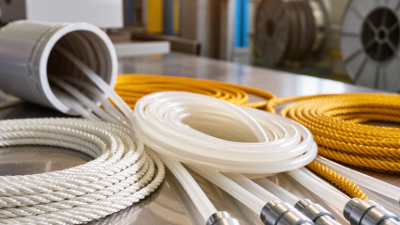
Choosing the right wire pulling rope has become a practical concern for contractors, distributors, and infrastructure buyers worldwide. Different projects demand different strength, flexibility, grip, and abrasion resistance. A compact polyester rope may suit indoor conduit work, while a steel wire rope may handle harsher industrial conditions. Aramid options can reduce weight, but their higher price requires careful justification.
This guide examines the leading wire pulling rope types expected to attract global buyers in 2026. It considers braided construction, tensile capacity, bending performance, surface wear, moisture exposure, and storage conditions. Product labels alone are not enough. Buyers should review test data, rope diameter, breaking load, connector quality, and compatibility with pulling equipment. A rope that performs well in a dry warehouse may behave differently inside a dusty duct or beneath strong sunlight.
Details matter.
Practical experience shows that selection errors often begin with one simple assumption: stronger always means better. That assumption can fail when a rope becomes too stiff, too heavy, or difficult to control around tight bends. Cost also needs a wider view, including replacement frequency, transport weight, labor time, and downtime risks. No product is perfect. Even respected manufacturers may present specifications differently, which makes direct comparison difficult. Reliable purchasing therefore combines verified documentation, supplier communication, and realistic field requirements. This introduction provides a clear starting point for comparing materials and identifying the most suitable wire pulling rope for regional and international applications.
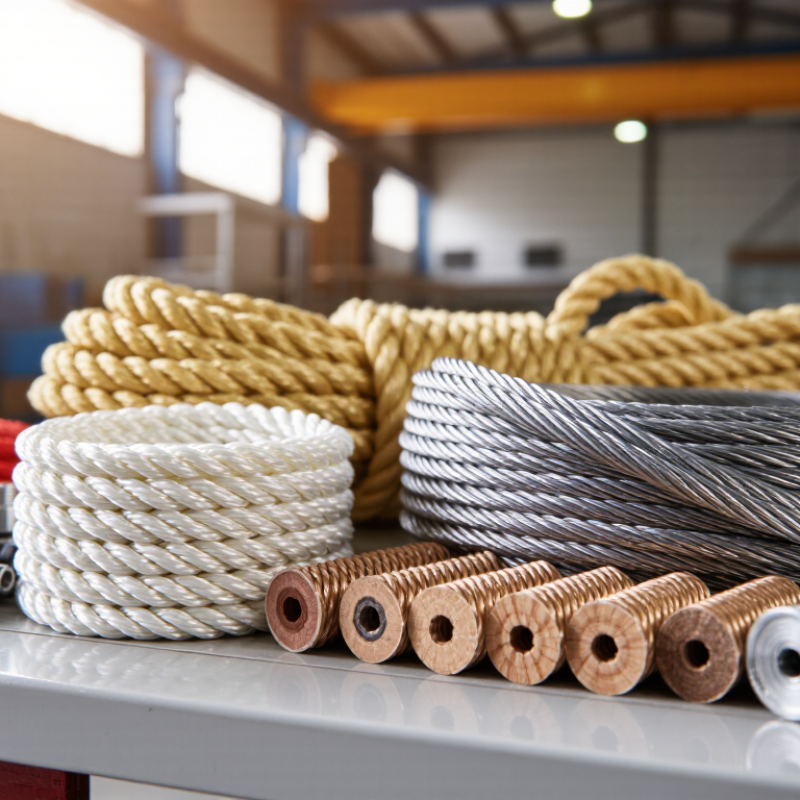
For global buyers in 2026, wire-pulling rope selection starts with the application, not the price. Steel rope remains a strong choice for high-tension pulls and repeated industrial use. It resists cutting and crushing better than many synthetic options. However, steel adds weight, conducts electricity, and may scratch sensitive conduit surfaces. Galvanized protection helps, but corrosion can still appear near damaged strands.
Nylon rope offers excellent shock absorption during sudden tension changes. It is flexible and suitable for bends, irregular routes, and moderate pulling loads. Moisture can increase its weight and reduce dimensional stability. Polyester provides lower stretch and better resistance to sunlight and moisture. It suits controlled pulls where consistent tension matters. Still, polyester can suffer from abrasion when dragged over rough edges.
UHMWPE delivers exceptional strength with very low weight. A technician can handle a long rope more easily, especially in elevated or confined work areas. Its low stretch improves pulling control, but heat, sharp edges, and repeated bending require careful management. No rope is perfect. That matters.
A reliable specification should compare breaking strength, working load, diameter, bend radius, elongation, surface finish, and termination quality. Inspect the rope before every pull. Look for flattened sections, broken fibers, rust, glazing, or damaged eyes. I would also test the actual route, because a laboratory rating cannot predict every field condition. The neatest selection may still fail if workers exceed the safe working load or ignore poor alignment.
| Rope Type | Material and Typical Construction | Typical Specific Gravity | Typical Minimum Elongation at Break | Representative Tensile Strength Range | Flexibility and Handling | Resistance Profile | Best-Fit Wire-Pulling Applications | Main Limitations | Buyer Selection Priorities |
|---|---|---|---|---|---|---|---|---|---|
| Galvanized Steel Wire Rope | High-carbon steel wires arranged in stranded constructions such as 6 × 19 or 6 × 36; commonly supplied with a fiber or steel core. | Approximately 7.85 | Approximately 1%–3%, depending on wire grade and construction. | Approximately 1,570–1,960 MPa wire tensile grade; finished-rope breaking force depends on diameter, strand design, and core. | High strength and good dimensional stability; less lightweight and less forgiving around tight bends than synthetic rope. | Good resistance to heat, cutting, and mechanical crushing. Galvanizing improves corrosion resistance, but saltwater and chemical exposure can still cause corrosion. | Long-distance pulling where high line tension, low stretch, and strong abrasion resistance are required; heavy cable and utility-conduit work. | Heavy, conductive, potentially abrasive to cable jackets, and vulnerable to corrosion if the coating or wires are damaged. Requires inspection and lubrication practices. | Select the correct nominal diameter, rope construction, core type, safety factor, bend radius, corrosion protection, and compatible pulling equipment. |
| Nylon Rope | Usually braided or laid polyamide rope; common forms include 3-strand, 8-strand, and double-braid constructions. | Approximately 1.14 | Approximately 15%–35%, with higher stretch possible under dynamic loading. | Approximately 600–1,000 MPa fiber tensile strength; finished-rope capacity varies significantly by construction and diameter. | Very flexible, easy to coil, and highly shock-absorbent. Stretch can help reduce peak loads but may reduce pulling control. | Good abrasion resistance and good resistance to repeated flexing. Absorbs water, which increases weight and can reduce strength when wet. Sensitive to prolonged ultraviolet exposure and strong acids. | General-purpose cable pulling, temporary pulling lines, jobs requiring flexibility, and applications where load shocks may occur. | High elongation can make tension monitoring less precise; wet strength and dimensional behavior must be considered. Not ideal for applications requiring very low stretch. | Check wet-strength retention, elongation at the intended working load, UV stabilization, braid design, eye-splice quality, and pulling tension limits. |
| Polyester Rope | Typically braided or double-braid polyethylene terephthalate fiber rope; engineered for stable handling and moderate stretch. | Approximately 1.38 | Approximately 10%–18%, depending on construction and load level. | Approximately 600–900 MPa fiber tensile strength; finished-rope breaking force depends on diameter and braid efficiency. | Flexible and comparatively stable under load; usually easier to control than nylon when consistent rope length is important. | Very low water absorption, good ultraviolet resistance, good abrasion resistance, and strong resistance to many common chemicals. Melting point is typically around 250–260°C. | Outdoor and utility-cable pulling, wet or humid environments, repeated handling, and applications needing lower stretch than nylon. | Generally heavier than nylon and less elastic for absorbing sudden shock loads. Can be damaged by excessive heat, sharp edges, or localized crushing. | Prioritize low elongation under working load, UV resistance, wet-environment performance, abrasion cover, splice efficiency, and minimum bend radius. |
| UHMWPE Rope | Ultra-high-molecular-weight polyethylene fiber rope, commonly made as a braided high-strength line with a protective cover for abrasion-sensitive work. | Approximately 0.97 | Approximately 2%–4%, depending on fiber grade and rope construction. | Approximately 2,500–3,500 MPa fiber tensile strength; finished-rope capacity is construction- and diameter-dependent. | Extremely lightweight with very high strength-to-weight ratio; low stretch and easy manual handling, but requires protection from sharp edges and localized heat. | Floats in water and has very low moisture absorption. Good resistance to many chemicals and abrasion when properly covered; comparatively sensitive to heat, frictional glazing, and some UV exposure without stabilization. | High-strength, low-weight pulling lines, long-distance cable installation, difficult-access sites, and operations where reducing manual handling weight is important. | Lower heat tolerance than steel and some conventional synthetic ropes; can creep under sustained load and may suffer fiber damage from sharp bends, excessive compression, or poor termination. | Verify fiber grade, creep behavior, protective cover, termination efficiency, heat exposure, bend radius, inspection method, and working-load limit. |